Status: 🟢 Operational
Overview
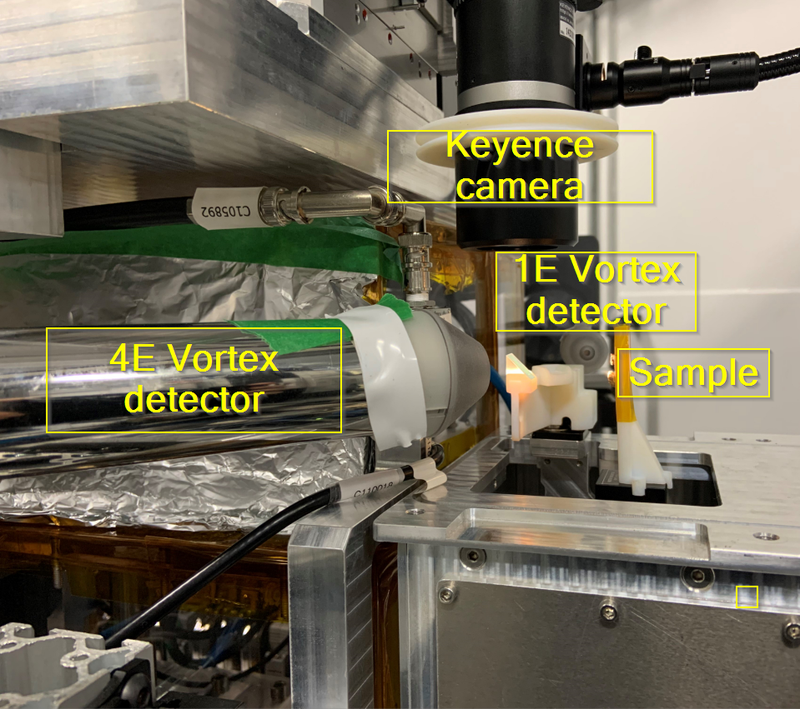
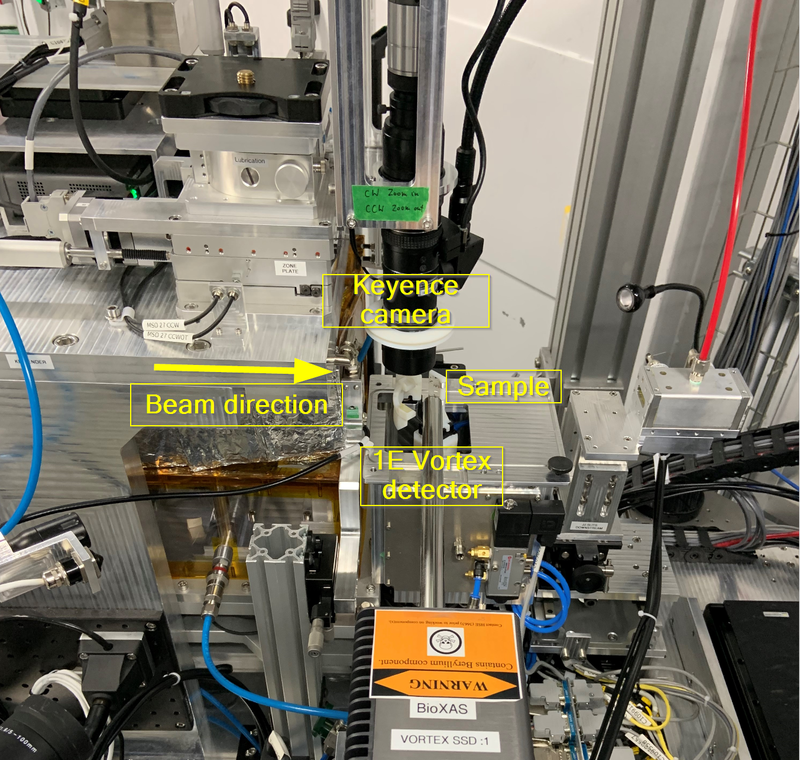
Designed for experiments that require greater/equal resolution to 10 μm. There are two stage-configuration available depending on the sample thickness. The 45 degrees stage-configuration with respect to the incident beam are generally set up for cross-sections varying from a few μms to a couple of hundreds of μms. For thicker samples reaching mm range, the 90 degrees stage-configuration is used.
Specifications
-
Beam focused by KB mirrors
-
Step-based or bi-directional fly imaging
-
Sample stage at either 90 or 45 degress to the incoming beam
-
Keyence camera with long working distance (85 mm), high zoom (variable) lens for sample visualization
-
Samples in ambient air or He gas box
-
Cryo Jet/LN2 for sample cooling (to be commissioned)
Beam size and flux
Beam spot sizes measured at 45 degrees (meaning ~1.41X increase in beam H size) and at 10 keV (5th harmonics):
-
10 μm (H) x 5 μm (V) flux 3.2 x 10¹¹ ph/s/100 mA (full focused beam limited only by the acceptance of the KB mirrors)
-
6 μm (H) x 5 μm (V) flux 1.5 x 10¹¹ph/s/100 mA (beam cut horizontally at the secondary source)
Techniques
-
X-ray fluorescence imaging (XFI)
-
X-ray absorption spectroscopy (XAS)
-
X-ray absorption spectroscopy in situ (u-XAS)
Examples
-
Stage configuration at 45 degrees to the incident beam
-
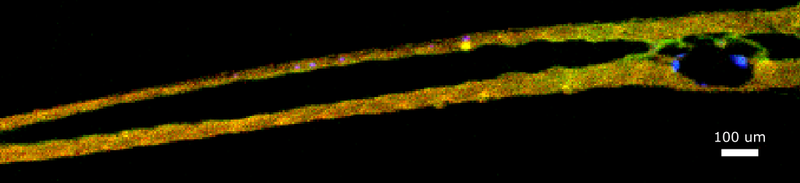
The imaging data were collected at a resolution of 5 um at 100 ms dwell time
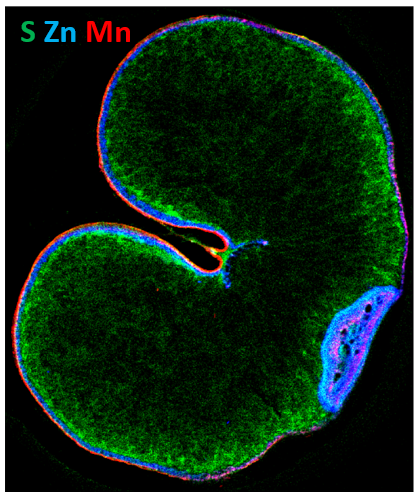
Distribution of Micronutrients in Arborg Oat (Avena sativa L.) Using Synchrotron X-ray Fluorescence Imaging (Deng et al., 2023).
Setups
The stage configuration can be changed depending on the thickness of the sample.
Stage configuration set at 45 degrees
Stage configuration set at 90 degrees